Begin with a report, not a tank size
Orange staining is a reason to investigate, but it is not enough information to size equipment. Ask which laboratory measurements are needed to distinguish the treatment problem. Iron concentration and form matter, and other parameters such as pH, hardness, manganese, and organic material may affect the recommendation.
Tell the provider about odors, slime, particles, and when staining occurs. Existing filters and softeners can change the sample, so discuss where the sample should be collected. Keep the report with its units and sample location. A number copied without its units or taken from treated water may lead to a very different conclusion from a properly documented untreated-water result.
Understand dissolved iron versus particles
Some iron is dissolved in water when it enters the house; some is already oxidized into particles. A sediment cartridge may capture particles within its rating but allow dissolved iron through. That is why a filter can look dirty while staining continues downstream.
Treatment may need to change dissolved iron into a form that filtration can remove. The choice of process depends on the chemistry and equipment design. Avoid interpreting labels such as whole-house, premium, or multistage as proof that a device will address your particular result. Ask for the operating limits and an explanation tied to your water report.
When can a softener help?
Some softeners can handle limited amounts of certain dissolved iron under suitable conditions. That does not mean every softener is an iron-removal system. Iron can increase maintenance demands or interfere with operation when the water falls outside the equipment's intended range.
If a proposal uses a softener for iron control, ask which measured conditions support that choice and what maintenance it requires. Also ask whether hardness is a separate problem. Our water softener information explains that service option, but the equipment selection should follow the report rather than an assumption that all staining needs salt-based softening.
What does a dedicated iron filter do?
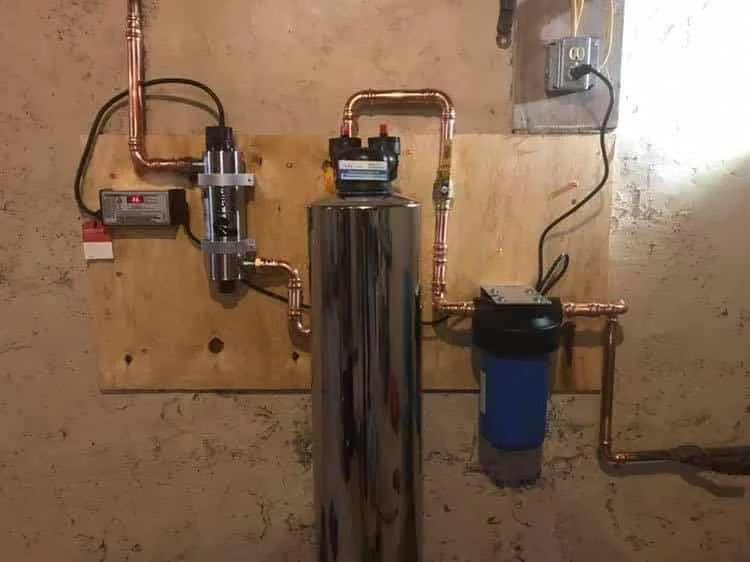
Dedicated systems may use oxidation and filtration, sometimes with chemical feed, contact time, or other stages. Different media have different requirements. The presence of manganese, organic material, or other conditions may change what works reliably.
Backwashing systems need enough available water flow to clean the media. A household with a limited well yield or unsuitable pump performance needs that constraint considered before installation. Drainage arrangements and space also matter. Ask the installer to explain service flow, backwash needs, waste discharge, and what happens during cleaning cycles. A larger tank is not automatically an improvement if the water system cannot support it.
Treat iron bacteria and drinking-water safety as separate questions
Slime or recurring deposits may require evaluation of iron bacteria and the well system. Simply installing another cartridge may not address those conditions. A well or treatment professional should determine the appropriate approach; do not add disinfectant using a generic recipe without assessing the installation.
Iron treatment also should not be presented as proof that the water is safe to drink. Bacteria, nitrate, and other potential contaminants need their own testing and any required treatment. No single technology handles every possible water problem. Discuss health-related test results with the laboratory or local health department, and ask for equipment claims that match the substances actually being treated.
Compare the complete system and ongoing work
A useful proposal identifies each stage and its purpose, the measured water conditions used for sizing, and the expected operating requirements. Ask about electrical use, consumables, filter changes, salt or chemical needs where applicable, and professional maintenance. Find out which routine tasks the homeowner is expected to perform and what happens if maintenance is missed.
Also clarify the planned sampling points and how performance will be checked after installation. The goal is not just clearer water on the first day. The system should operate predictably at household demand and remain maintainable. Written operating instructions and a service contact are as important as the product name on the invoice.
Where does reverse osmosis fit?
A drinking-water unit at one sink serves a different purpose from whole-house treatment. It does not protect every shower, fixture, or appliance from staining. Significant iron can also challenge downstream equipment, so pretreatment may be needed before a drinking-water system.
Do not assume that adding stages always improves results. The stages should solve identified problems in a sensible order. For a Pine Bush home or a property elsewhere in Orange, Ulster, or Sullivan County, the starting point remains the individual water report and installation. Review our whole-house filtration service or water treatment options to discuss an assessment.
Check results and keep monitoring
After installation, follow the specified startup procedure and have performance checked at appropriate locations. Keep before-and-after results so future changes can be distinguished from the original conditions. Staining may take time to clean from existing fixtures, so old marks alone do not tell you whether treatment is working now.
Continue periodic water testing and investigate new odors, color, or flow changes. A private well can change, and equipment can require adjustment or maintenance. If the supply suddenly turns brown, read our guide to brown well water rather than assuming the filter simply needs a different setting.
Frequently asked questions
Will any whole-house filter remove iron?
No. Filter claims depend on the device and conditions. Confirm that the proposed equipment is intended for the form and concentration found in your water.
Do I need a softener and an iron filter?
Possibly, if separate hardness and iron conditions justify both. Some homes need a different arrangement. Testing and equipment limits should determine the stages.
Can clear water still contain iron?
Yes. Dissolved iron may not be visible initially. Appearance is not an adequate substitute for testing when selecting treatment.
Does an iron filter make well water safe?
It addresses the contaminants specified for that system, not every possible hazard. Drinking-water safety requires appropriate testing and treatment for each identified concern.
Sources & further reading
- Minnesota Department of Health: Iron in Well Water
- Penn State Extension: Iron and Manganese
- CDC: Guidelines for Treating Well Water
- Minnesota Department of Health: Iron Bacteria
General homeowner information. Follow the instructions for your specific equipment; a symptom alone is not a diagnosis.